
 24 Mar 2026
Published by Aspen Dentals, Gurgaon · 6 min read
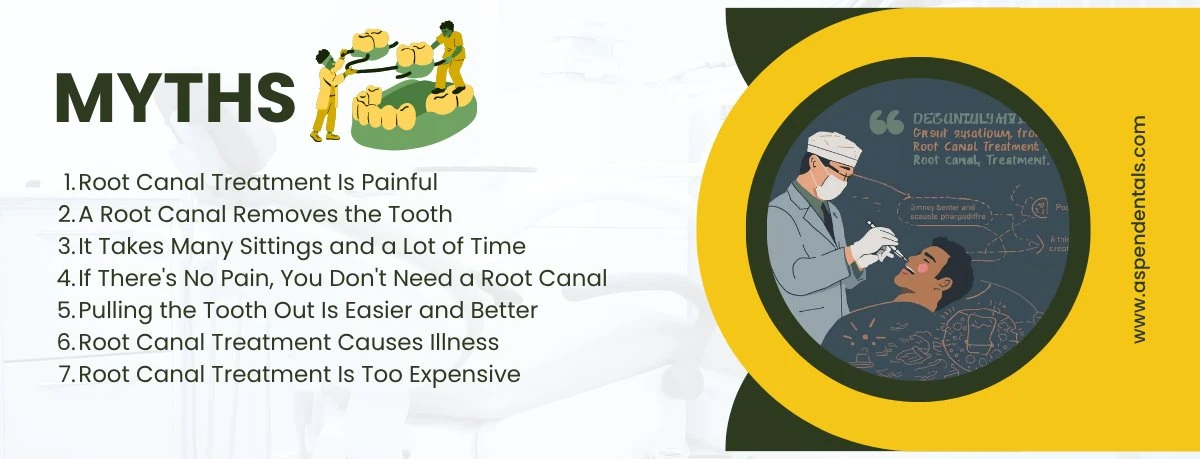
Let's be honest. When someone suggests that you need a root canal, the first thing you probably feel is dread. Maybe you've heard stories from a friend, or watched one too many dramatic clips online. Whatever the reason, root canal treatment — or RCT — has somehow earned a reputation as the most terrifying thing that can happen at a dentist's clinic.
But here's the thing: most of what people 'know' about root canals isn't true anymore. Dentistry has changed a lot. At Aspen Dentals in Gurgaon, we see patients every single week who come in absolutely terrified — and leave wondering why they waited so long. Today, we're setting the record straight.
In This Article
- Root Canal Treatment Is Painful
- A Root Canal Removes the Tooth
- It Takes Many Sittings and a Lot of Time
- If There's No Pain, You Don't Need a Root Canal
- Pulling the Tooth Out Is Easier and Better
- Root Canal Treatment Causes Illness
- Root Canal Treatment Is Too Expensive
Myth 01
Root Canal Treatment Is Painful
The Myth
"Root canal is the most painful dental procedure you can go through."
The Reality
The procedure itself doesn't cause pain. It relieves it.
This is the biggest and most stubborn myth out there. And it makes sense that it spread — because decades ago, before modern anaesthesia and techniques were what they are today, root canals were uncomfortable. But things are very different now.
Today, the entire procedure is done under local anaesthesia. You will feel pressure during the treatment, yes, but not the sharp, unbearable pain that people imagine. Most of our patients at Aspen Dentals are surprised by how straightforward it feels. Some even doze off mid-procedure.
The real pain is almost always the toothache that was there before the treatment. The RCT is what ends that pain.
See the signs that might mean you need an RCT ↓
Myth 02
A Root Canal Removes the Tooth
The Myth
"They pull out the tooth during a root canal."
The Reality
Root canal treatment saves your tooth. Nothing is removed.
We hear this one quite often, and it causes unnecessary worry. People sometimes confuse root canal treatment with a tooth extraction, which is a completely different procedure.
Here is what actually happens during a root canal. The dentist clears the infected or dead pulp from inside the tooth — the soft tissue in the centre of the tooth. The tooth itself stays exactly where it is. After cleaning the inside, the tooth is filled and sealed, and usually a crown is placed on top to protect it.
Your tooth stays in your mouth. You can continue eating, smiling, and living your life with it. The goal of an RCT is to save the natural tooth rather than remove it.
Wondering if extraction is a better option? Read Myth 5 ↓
Myth 03
It Takes Many Sittings and a Lot of Time
The Myth
"Root canal treatment takes weeks and multiple visits."
The Reality
Most cases are completed in one to two sittings.
People often imagine that a root canal is a long, drawn-out process that will require multiple days off work, several painful appointments, and disrupt their entire life. That's not quite how it works anymore.
A straightforward root canal can be completed in a single sitting at our clinic, lasting 45 to 90 minutes. More complex cases — such as back molars with multiple roots or severe infection — may require two sittings. But even then, it's usually wrapped up within a week or two.
Many of our patients in Gurgaon come in during their lunch break, get the procedure done, and return to their offices the same afternoon.
Myth 04
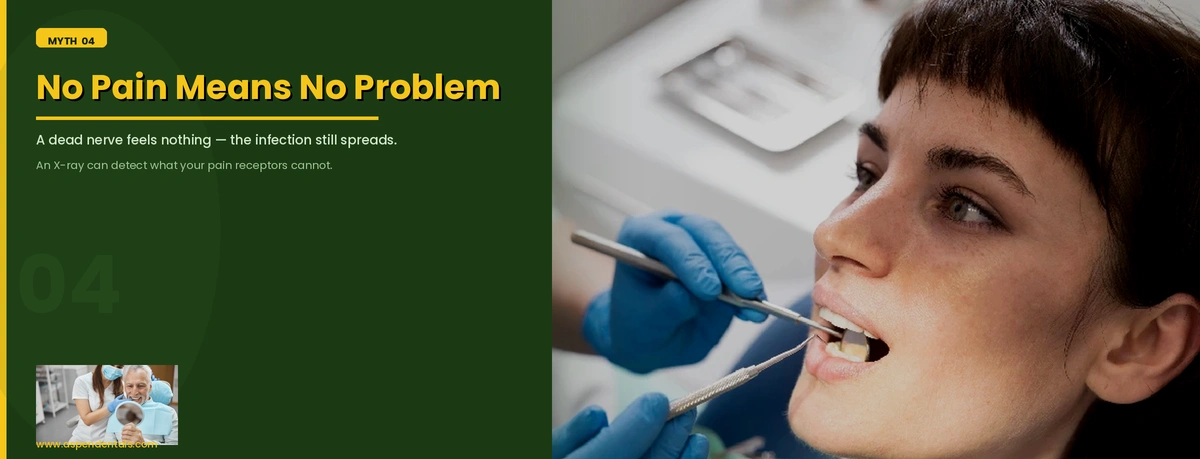
If There's No Pain, You Don't Need a Root Canal
The Myth
"My tooth doesn't hurt, so it must be fine."
The Reality
A tooth that has lost its nerve may feel no pain but still be seriously infected.
This is a dangerous one. Many people assume that pain is the only indicator of a problem. So if the tooth stops hurting on its own, they feel relieved and skip the dentist visit.
Here's what can actually happen. When the infection inside the tooth completely destroys the nerve, the pain disappears. But the infection does not. It continues to spread silently — into surrounding bone, tissues, and teeth. By the time it causes visible swelling or other symptoms, the situation has often become significantly more complicated.
This is why we always recommend not ignoring dental check-ups, even when you feel fine. A dental X-ray can detect what your eyes and pain receptors cannot.
Check the warning signs you should never ignore ↓
Myth 05
Pulling the Tooth Out Is Easier and Better
The Myth
"Why go through all of this? Just pull the tooth and be done with it."
The Reality
Losing a natural tooth creates a different set of problems. RCT is almost always the better long-term choice.
We completely understand the logic here. If a tooth is causing problems, why not just remove it and be done with it?
But tooth extraction comes with its own long list of consequences. When a tooth is pulled out and not replaced, the neighbouring teeth begin to shift towards the gap. This affects your bite and jaw alignment and, over time, can lead to bone loss in that area. You may then need a dental implant or a bridge, which is often more expensive than the root canal treatment would have been in the first place.
Natural teeth are incredibly strong and perfectly fitted to your jaw. Root canal treatment lets you keep that tooth. Extraction might sometimes be the only option in severely damaged cases — but when RCT can save the tooth, it should always be the first choice.
Concerned about the cost? Read Myth 7 ↓
Myth 06
Root Canal Treatment Causes Illness
The Myth
"Root canals can cause cancer or other diseases spreading through the body."
The Reality
This claim has been thoroughly studied and debunked. There is no scientific evidence linking RCT to systemic illness.
There is a theory that has been circulating online for years — based on old, flawed research — claiming that root canal-treated teeth somehow cause heart disease, cancer, or other systemic illnesses.
Dental and medical researchers have extensively studied this. The conclusion is clear: there is no credible scientific evidence supporting this claim. The original research was conducted over a hundred years ago using methods that do not meet modern scientific standards. Major dental organisations worldwide, including the Indian Dental Association, stand firmly behind the safety of root canal treatment.
Untreated dental infections, on the other hand, can spread to other parts of the body and cause serious complications. Treating the infection — which is exactly what RCT does — is what keeps you safe.
Myth 07

Root Canal Treatment Is Too Expensive
The Myth
"RCT costs a fortune. I can't afford it."
The Reality
When you factor in long-term costs, RCT is often the most cost-effective option.
Cost is a very real concern, and we take it seriously. Yes, root canal treatment costs more upfront than a simple filling. But here is what many people don't consider.
Delaying or skipping RCT usually leads to more serious problems — the infection spreads, requiring an extraction, then an implant or bridge to replace the missing tooth. Each of these steps adds cost. By the time you've paid for all of that, you've likely spent much more than the root canal would have cost.
At Aspen Dentals in Gurgaon, we offer transparent pricing, flexible payment options, and will always walk you through exactly what your treatment involves and what it will cost before we begin anything.
Warning Signs You Might Need a Root Canal
You don't have to wait until things get very bad. Here are some signs that are worth getting checked out sooner rather than later:
- A toothache that lingers, especially after eating or drinking something hot or cold
- A tooth that is very sensitive even when you're not eating or drinking
- Swelling in the gum area near a tooth
- A small bump or pimple-like appearance on the gum
- Darkening or discolouration of a tooth
- Pain that throbs or radiates to your jaw or ear
If you're experiencing any of these, it doesn't necessarily mean you need a root canal — but it does mean you should see a dentist. The sooner you get it checked, the simpler the treatment is likely to be.
Book a consultation at Aspen Dentals, Gurgaon ↓
What to Expect at Aspen Dentals If You Need an RCT
Here is a simple walkthrough of what happens when you come to us for root canal treatment in Gurgaon.
- Consultation and X-ray. We listen to your concerns, look at your X-rays, and explain exactly what is going on with your tooth. No rush, no pressure.
- Local anaesthesia. The area is made completely numb before we begin so you feel comfortable throughout.
- Pulp removal. The infected pulp inside the tooth is removed carefully using precision instruments.
- Cleaning and shaping. The inside of the tooth is cleaned, shaped, and made germ-free.
- Filling and sealing. The canal is filled with a specialised material and sealed to prevent re-infection.
- Crown placement. A crown is usually placed in a follow-up visit to protect the tooth and restore its full function.
You will be awake the whole time but comfortable. Most patients tell us it felt much easier than they expected.
Root canal treatment today is nothing like the scary procedure it once was. With the right dentist, the right technique, and the right support, it is a safe, effective, and genuinely manageable experience. If you have been putting off getting a tooth checked out because of fear, come and talk to us. We're here to help you keep your teeth healthy and your smile intact.
Book Your Consultation at Aspen Dentals, Gurgaon
Painless RCT · Transparent Pricing · Experienced Team
Book Appointment Call / WhatsApp
Related: See the cost and what to expect on our root canal treatment in Gurgaon page, or book an appointment.
Frequently Asked Questions: Root Canal Treatment in Gurgaon
Is root canal treatment painful?
No. The procedure is done under local anaesthesia so that you won't feel sharp pain during the treatment. You may feel some pressure or mild discomfort, but nothing like the intense pain most people expect. If anything, the RCT relieves the toothache that was already there.
How many sittings does a root canal take at Aspen Dentals, Gurgaon?
Most root canals at our clinic are completed in one to two sittings, depending on the complexity of the tooth and the severity of the infection. We will give you a clear estimate after the initial examination and X-ray.
What is the cost of root canal treatment in Gurgaon?
The cost of RCT in Gurgaon varies depending on which tooth is involved (front teeth vs. back molars) and the extent of the infection. At Aspen Dentals, we offer transparent pricing and will walk you through the complete cost before starting any treatment. Contact us directly for a quote.
How long does recovery take after a root canal?
Most people feel back to normal within a day or two. There may be mild soreness around the treated area for a couple of days, which can be easily managed with over-the-counter pain relievers. Serious discomfort lasting beyond a week is uncommon and should be reported to your dentist.
Can I eat normally after a root canal?
You should avoid eating hard or chewy foods on that side until the final crown is placed. Once the crown is in, the tooth functions just like any other tooth, and you can eat normally.
Is root canal treatment safe?
Yes. Root canal treatment is one of the most commonly performed and well-studied dental procedures worldwide. It is safe, effective, and recommended by dental associations globally. Claims linking RCT to systemic illness have been thoroughly reviewed and debunked by researchers.
What happens if I delay getting a root canal?
Delaying an RCT allows the infection to spread further — into surrounding bone and tissue. What starts as a treatable infection can escalate to a situation where extraction becomes the only option. The earlier you treat it, the simpler and more affordable the solution will be.
What is the difference between root canal treatment and tooth extraction?
A root canal saves your natural tooth by removing the infected pulp, then sealing and capping it. Extraction removes the tooth entirely. RCT is almost always preferred when enough tooth structure remains, as it preserves your natural bite and avoids the need for implants or bridges.
Do I need a crown after a root canal?
In most cases, yes. A crown protects the treated tooth from cracking under chewing pressure and restores it to full function. Front teeth may not need a crown in some cases, but back molars almost always do.
How do I book a root canal appointment at Aspen Dentals in Gurgaon?
You can book through our website at www.aspendentals.com, call us directly, or WhatsApp us. Our team will confirm your appointment and answer any questions you have before you come in.


