
 28 Oct 2026
Lost a tooth and now you're staring at two options? You're not alone. The dental bridge vs implant question comes up in almost every consultation we have.
Both fill the gap and both look natural, but they work in very different ways. Here's how to tell which one suits you.
Dental Bridge vs Implant: The Basic Difference
A dental bridge is a false tooth held in place by the teeth on either side of the gap. Those neighbouring teeth are shaped and capped with crowns so the bridge can sit between them.
A dental implant is a small titanium post placed in the jawbone. It acts like a new tooth root, and a crown goes on top.
Here's the simple way to think about it:
- A bridge borrows support from your nearby teeth.
- An implant stands on its own and doesn't touch them.
What Does Each Option Cost in Gurgaon?
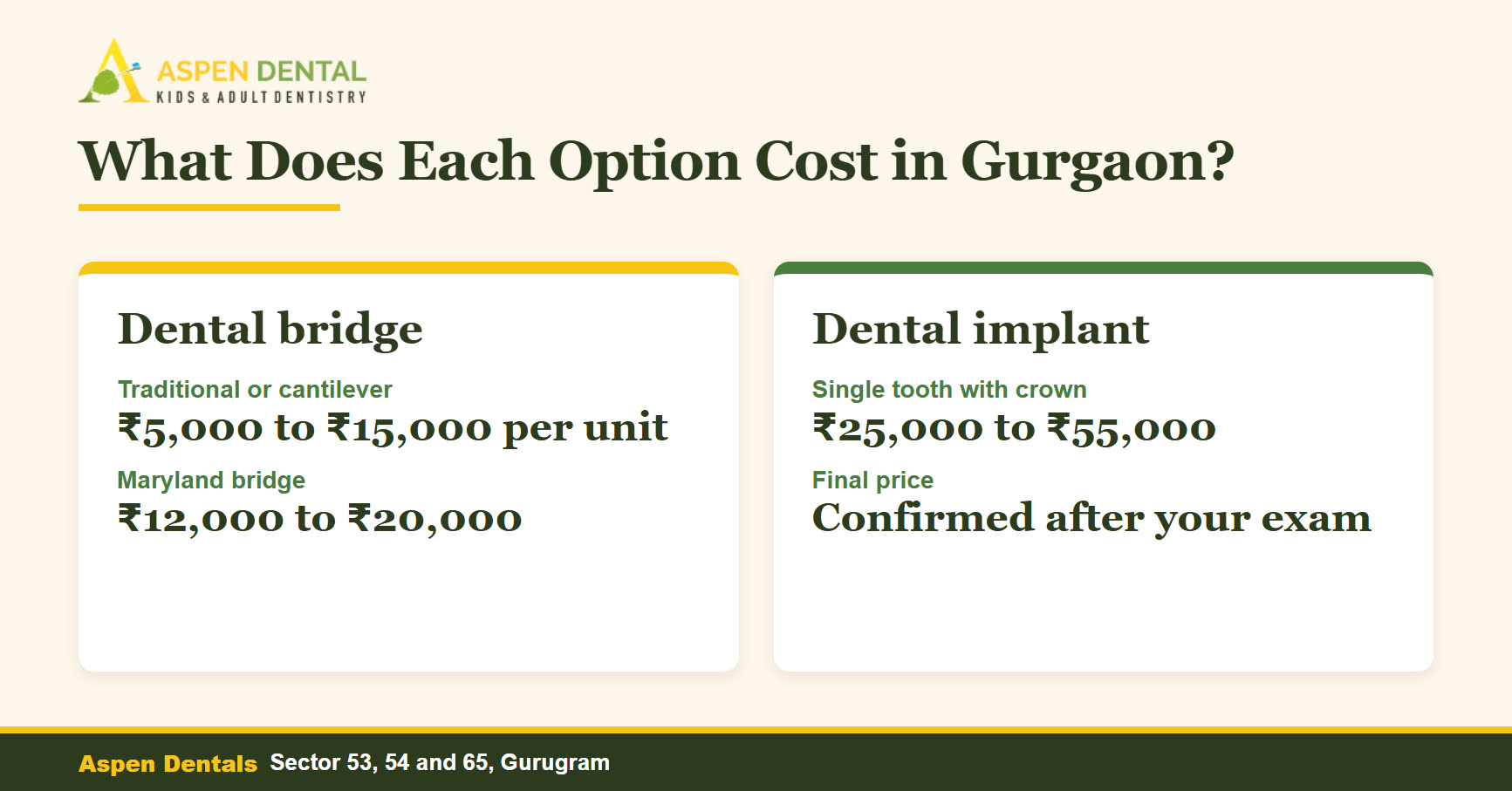
Money matters, so let's start there. At Aspen Dentals, a traditional or cantilever bridge costs ₹5,000 to ₹15,000 per unit. A Maryland bridge, which uses a thin metal wing instead of crowns, costs ₹12,000 to ₹20,000.
A single dental implant with a crown costs ₹25,000 to ₹55,000, depending on the case. You can read the full price breakdown in our dental implant cost guide.
So a bridge costs less today. Still, that's only part of the story, which brings us to the next point.
How Long Does Each One Last?
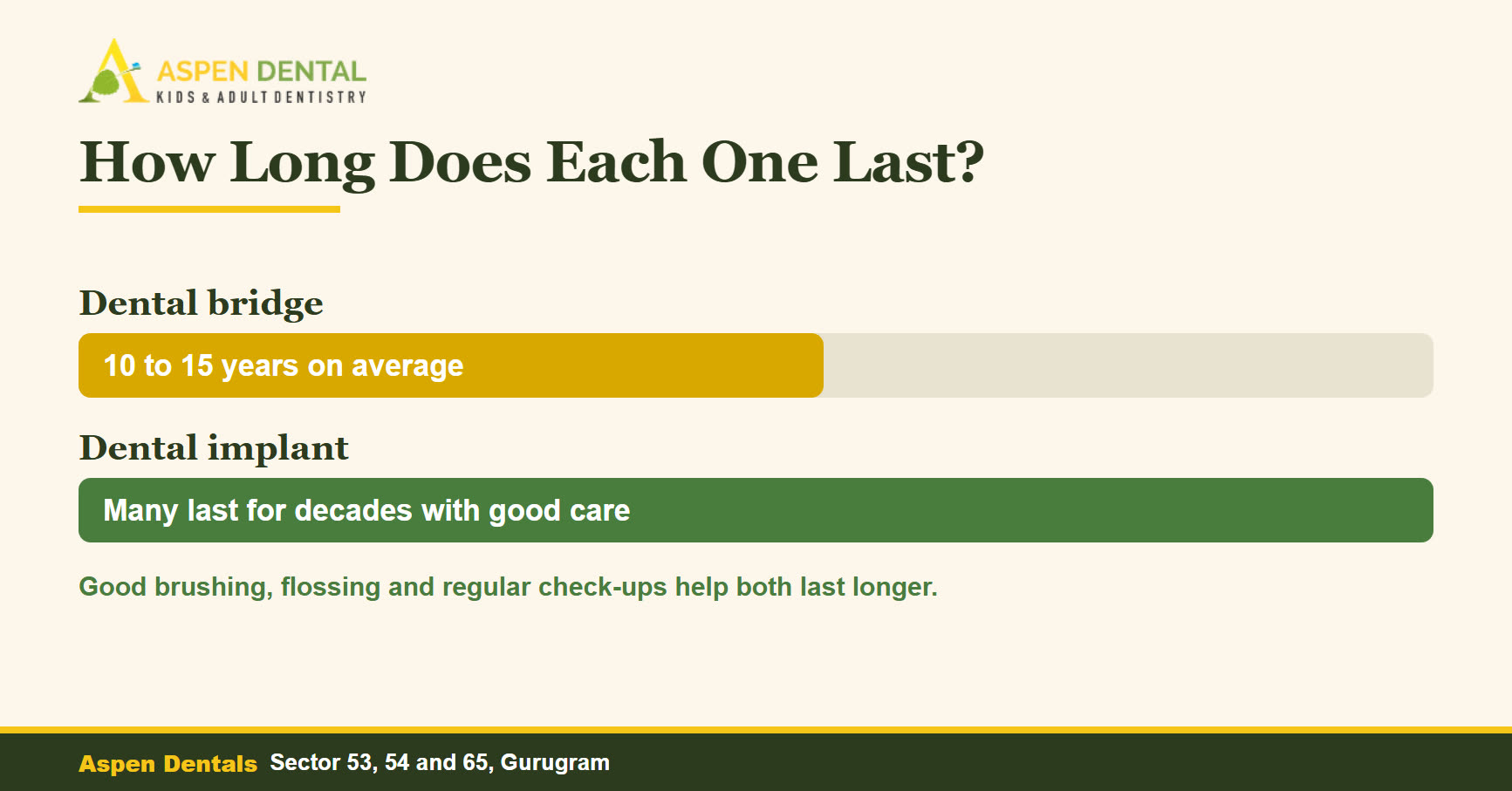
A well-looked-after bridge lasts 10 to 15 years on average. After that, it usually needs replacing.
Implants are built for the long haul. Many last for decades with good care, though it depends on your gum health and habits. Our guide on how long dental implants last explains what makes the difference.
Over a lifetime, one implant can work out cheaper than replacing a bridge two or three times.
Effect on Your Neighbouring Teeth
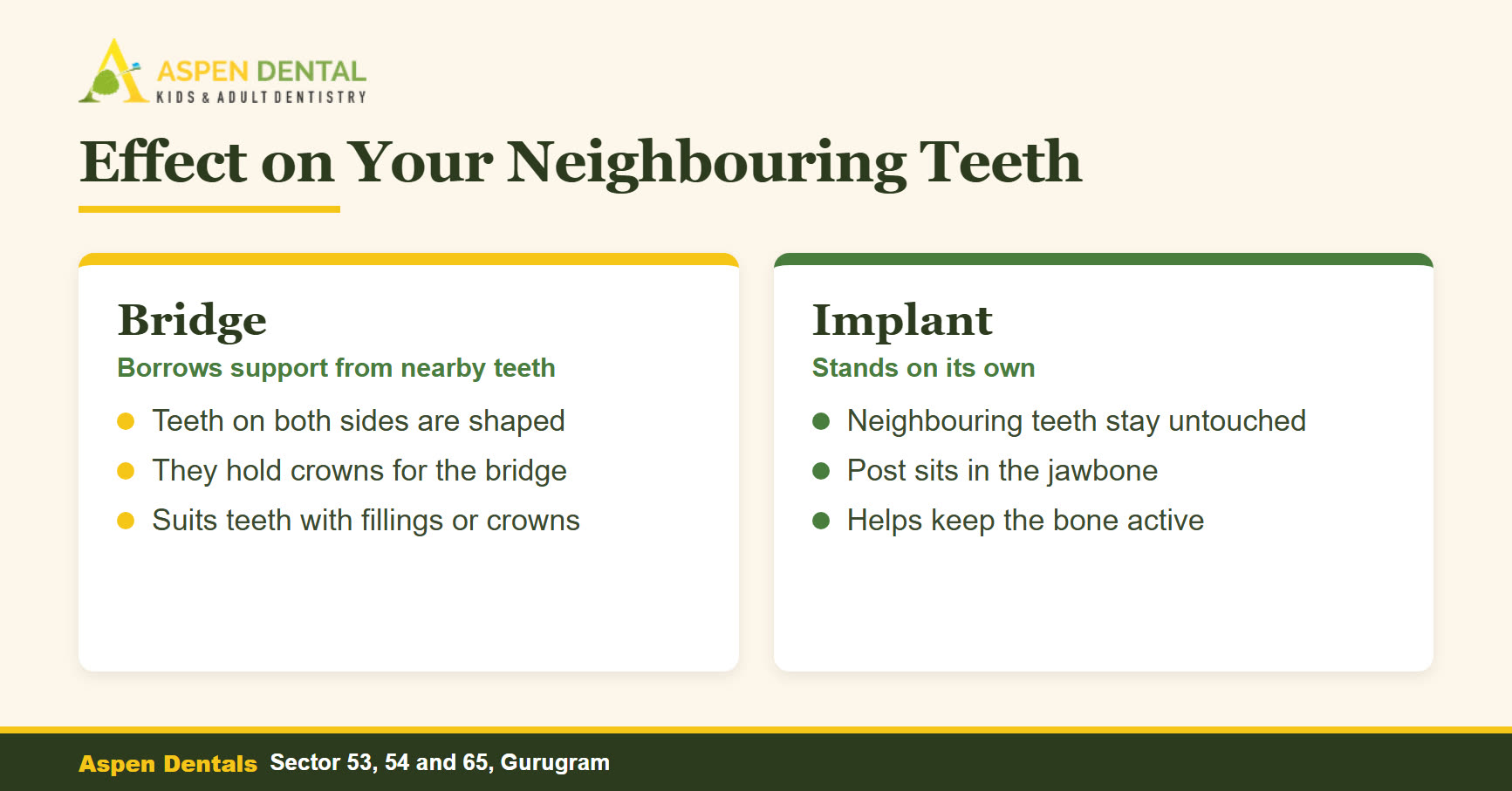
This is where the dental bridge vs implant choice often gets decided.
- Bridge: the teeth on both sides must be filed down to hold the crowns. If they're perfectly healthy, that's a real trade-off.
- Implant: your neighbouring teeth stay untouched.
An implant also keeps the jawbone active. When a tooth is missing, the bone under the gap slowly shrinks.
A bridge sits above the gum and can't stop that. An implant can.
Treatment Time and Recovery
Bridges are faster. You can usually get one in two visits over a couple of weeks, with no surgery.
Implants take longer. The post needs a few months to fuse with the bone before the final crown goes on. The procedure is done under local anaesthesia, and most people go back to normal activity quickly.
If you're short on time, a bridge is the quicker route. If you can wait, an implant pays off later.
Which One Is Easier to Keep Clean?
Both need good habits, but they feel different day to day.
- Bridge: you need a floss threader or small brush to clean underneath it. Food can collect there if you skip this step.
- Implant: you brush and floss it just like a natural tooth.
Who Is a Good Fit for a Bridge?
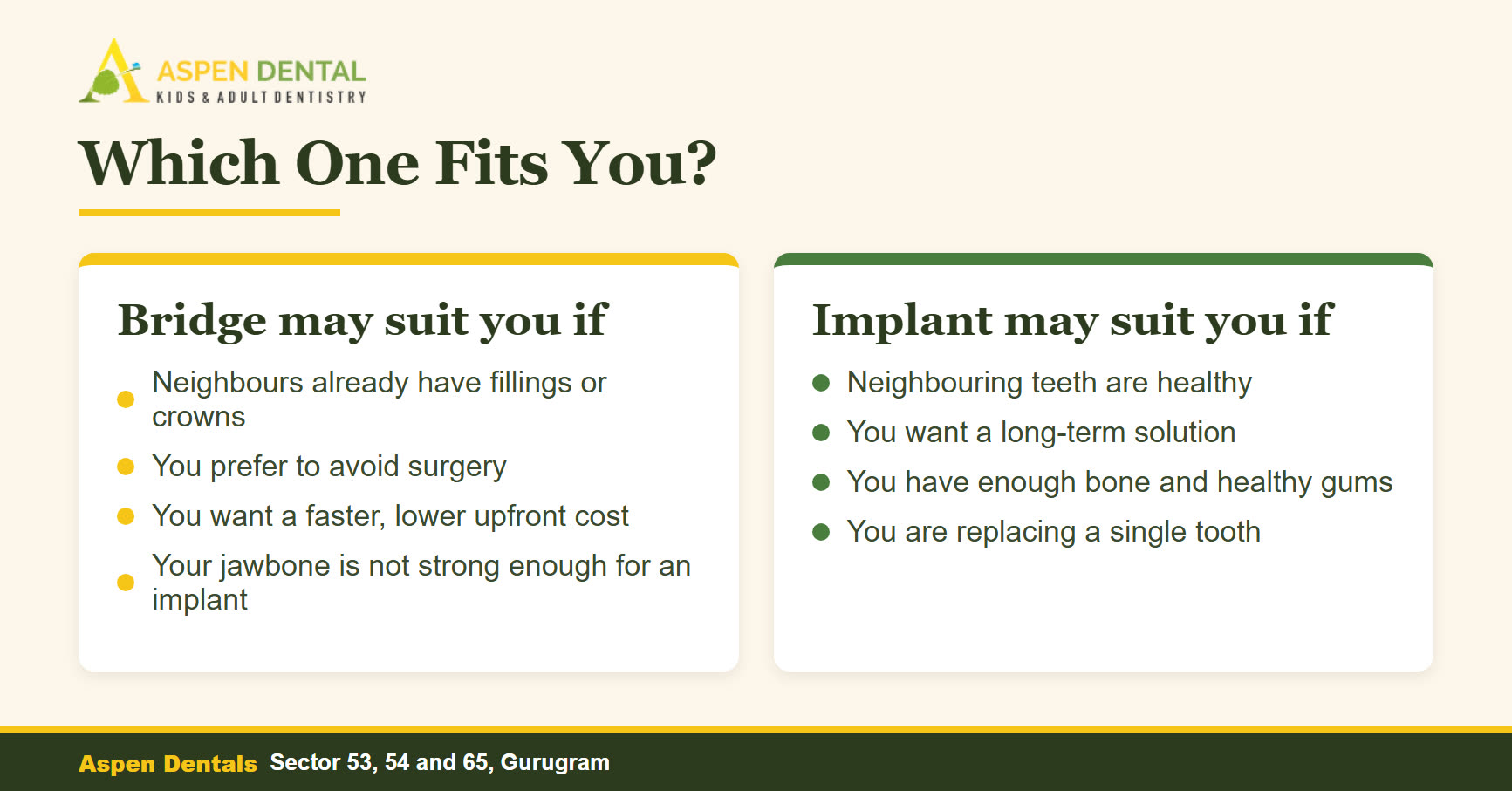
A bridge is often a good choice if:
- The neighbouring teeth already have large fillings or crowns.
- You'd rather avoid surgery.
- You want a faster result at a lower upfront cost.
- Your jawbone isn't strong enough for an implant.
Who Is a Good Fit for an Implant?
An implant tends to suit you if:
- Your neighbouring teeth are healthy and you'd like to protect them.
- You want a long-term solution.
- You have enough jawbone and healthy gums.
- You're replacing a single tooth and want it to feel natural.
For a deeper read on how implants are placed, see this NHS guide to dental implants.
What If You're Missing More Than One Tooth?
The dental bridge vs implant decision gets a little different when several teeth are gone. A bridge can replace a short row of missing teeth, as long as the teeth at each end are strong enough to carry the load.
For longer gaps, there's a middle path: an implant-supported bridge. Instead of leaning on natural teeth, the bridge sits on two or more implants. The price varies with the number of implants needed, so your dentist quotes it after an exam and X-ray.
Dentures are another option for many missing teeth. They cost less, but they don't feel as fixed as a bridge or an implant.
Questions to Ask Your Dentist Before You Choose
A short list can save you a lot of second-guessing. Take these to your consultation:
- Are the teeth next to my gap healthy enough to leave untouched?
- Do I have enough bone for an implant, or will I need a bone graft first?
- What's the full cost, including the crown and any extra visits?
- How long should this option last in my case?
- What daily cleaning will it need?
Good answers to these five questions usually make the choice obvious.
How to Decide Between a Dental Bridge and an Implant
The right dental bridge vs implant answer depends on your mouth, so no blog can pick for you. Your dentist will look at three things:
- The health of your gums and bone
- The condition of the teeth next to the gap
- Your budget and how long you want the result to last
At Aspen Dentals, we explain both options with real numbers before you decide. You can read more about our dental bridge treatment or book a consultation at our Sector 53, 54 or 65 clinic in Gurugram.
Related reading: dentures in Gurgaon: types, cost and what to expect.
Frequently Asked Questions
Dental bridge vs implant: which is better?
Neither wins in every case. A bridge is faster and cheaper upfront, while an implant lasts longer and protects the neighbouring teeth.
Which costs more, a bridge or an implant?
An implant costs more upfront: ₹25,000 to ₹55,000 against ₹5,000 to ₹15,000 per unit for a traditional bridge at Aspen Dentals.
Does getting a bridge damage the nearby teeth?
The teeth on either side must be shaped to hold the crowns. That's why bridges suit teeth that already have fillings or crowns.
How long does a dental bridge last?
Around 10 to 15 years with good care. Brushing, flossing and regular check-ups help it last longer.
Can I get a bridge if I don't have enough jawbone?
Yes. A bridge doesn't need bone support, so it works when bone loss rules out an implant.
Is the implant procedure painful?
It's done under local anaesthesia, so you feel pressure but not pain. Mild soreness afterwards usually settles in a few days.


